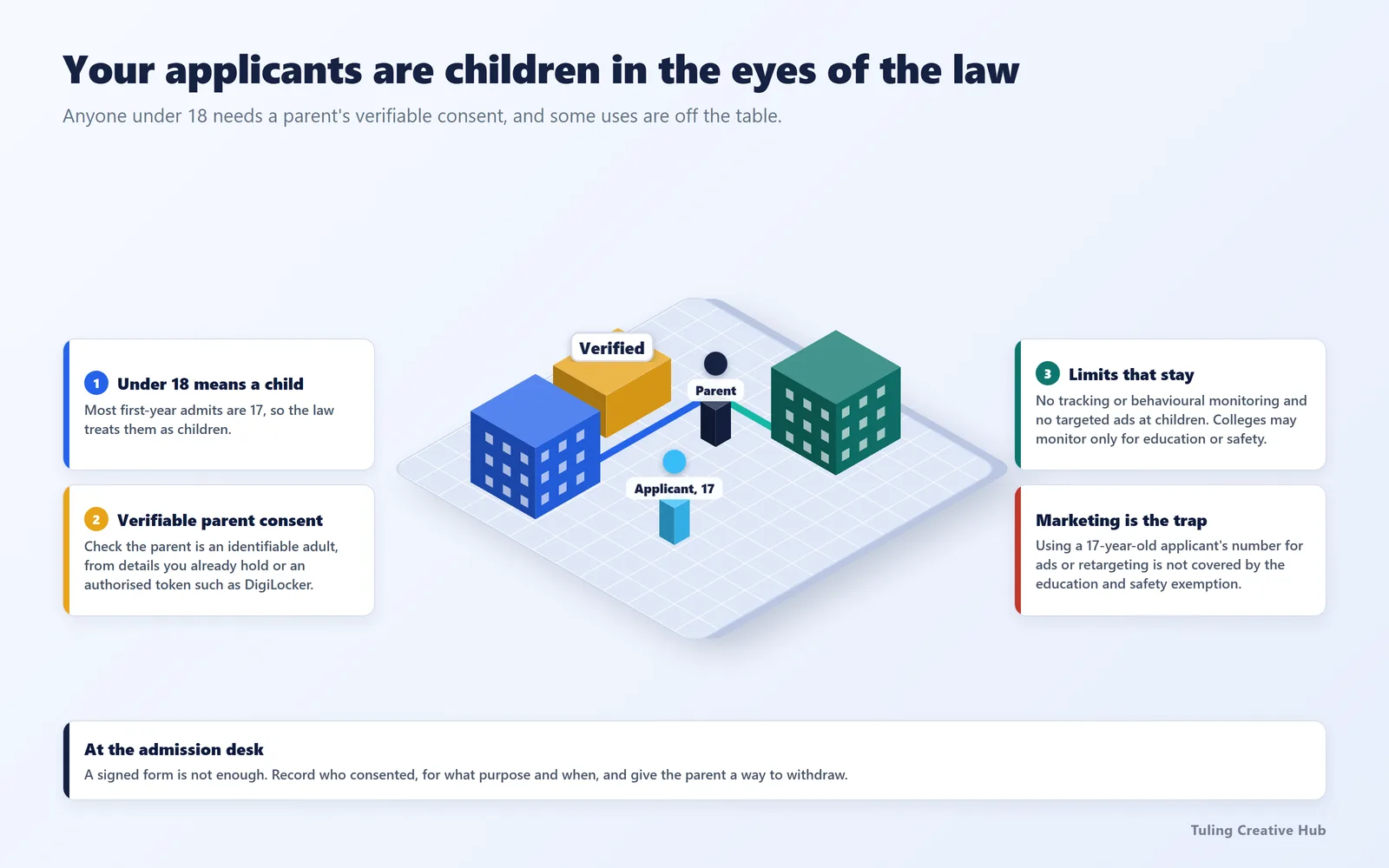
The short answer: a college processing digital personal data about someone under 18 should check the children’s-data requirements before it collects or uses that information. The general rule is verifiable consent from a parent or lawful guardian. The education-related exemption is narrow; it is not a blanket exception for admission data or marketing.
This supporting article is part of the DPDP Act for colleges series. For readiness steps, see the college DPDP checklist; for incident planning, see DPDP penalties and breach response.
Why do college applicants count?
The Act defines a child as an individual who has not completed 18 years of age (section 2(f)). This can include an applicant who has not yet enrolled. Colleges should therefore check age and data flows at the application stage, rather than assuming the rules apply only after admission.
The Act applies to digital personal data. If paper application records are later digitised, the digital records may be covered; purely paper records that remain undigitised are outside the Act’s scope while they remain paper-only.
What does the law generally require?
Section 9(1) requires a data fiduciary to obtain verifiable consent of a parent or lawful guardian before processing a child’s personal data. The Rules describe ways to establish that the person giving consent is an identifiable adult, including information already held by the fiduciary, information voluntarily provided by the parent or guardian, or specified virtual tokens and verification through an authorised entity.
An OTP sent to a number typed into an admission form can show control of that number, but does not by itself establish that the person is an identifiable adult or the applicant’s parent or lawful guardian. Assess the verification method against Rule 10 and the actual admission workflow; do not treat a phone number or checkbox alone as proof of verifiable parental consent.
Section 9 also addresses processing likely to cause a detrimental effect on a child’s well-being and restricts tracking or behavioural monitoring of children and targeted advertising directed at children, subject to the specific exemptions in the Rules.
What does the education exemption cover?
Rule 12 and Part A of the Fourth Schedule provide a limited exemption for an educational institution’s processing that is restricted to tracking or behavioural monitoring for the institution’s educational activities or for the safety of children enrolled there. The exemption should be assessed against the exact processing and purpose—not applied to every activity merely because a college performs it.
| Example | How to assess it |
|---|---|
| Attendance tracking used for an educational activity | Check that the actual purpose and processing meet the narrow exemption |
| Monitoring used for enrolled children’s safety | Document the safety purpose, data involved and access |
| Admission form containing marks, identity or parent details | Do not assume the education exemption removes the general parent-consent requirement |
| Using an applicant’s contact details for advertising | Do not assume the education exemption covers marketing or targeted advertising |
| A learning tool that tracks student behaviour | Assess what it monitors, why, and whether it is within the exemption; obtain legal advice where uncertain |
Part B of the Fourth Schedule contains additional purpose-specific exemptions. Check the exact Schedule entry before relying on one.
What should admissions and student services check?
- Identify where applicants under 18 provide digital personal data, including through online forms, email and messaging tools.
- Record the purpose for each data item and determine the applicable legal basis.
- Design a process to obtain and evidence verifiable parent or lawful-guardian consent where required.
- Separate admission and education uses from promotional or advertising uses.
- Inventory vendors that receive applicant or student data and review their contracts and safeguards.
- Document why any tracking or monitoring is used and whether a narrow exemption applies.
- Give staff a way to escalate uncertain cases before they export, share or reuse a child’s data.
The 24-week preparation checklist turns these checks into a broader programme. The deadline guide explains the phased commencement dates.
Sources
- Ministry of Electronics and Information Technology, The Digital Personal Data Protection Act, 2023: sections 2(f) and 9.
- Ministry of Electronics and Information Technology, The Digital Personal Data Protection Rules, 2025: Rules 10 and 12 and the Fourth Schedule.
This post explains the law in general terms and is not legal advice.
Update log
- 14 November 2026: first published.
- 18 November 2026: refocused on children’s data and clarified the limits of the education exemption.
- 19 November 2026: clarified what an OTP does and does not establish for parental verification.
Frequently asked questions
Are applicants under 18 children under the DPDP Act?
Yes. The Act defines a child as anyone who has not completed 18 years. If a college processes digital personal data about an applicant under 18, the children's-data provisions may apply even before enrolment.
Do colleges need parent consent for admission data?
Section 9(1) requires verifiable consent of the parent before processing a child's data. An OTP to a number supplied on a form does not, by itself, establish an identifiable adult or parent. The educational-institution carve-out in the Fourth Schedule covers tracking and behavioural monitoring for education or safety, not ordinary admission processing.
Does the education exemption remove the need for parent consent?
No. It switches off sections 9(1) and 9(3) only for processing restricted to tracking and behavioural monitoring for the institution's educational activities or the safety of enrolled children. Other processing still needs verifiable parent consent.
Does the education exemption cover an admission form?
The stated exemption is limited to specified tracking and behavioural monitoring for educational activities or the safety of enrolled children. It should not be treated as a general exemption for collecting application data.
Can a college use an under-18 applicant's number for marketing?
Do not assume it can. The Act restricts targeted advertising directed at children, and the education-related carve-outs are narrow. Have the specific purpose and legal basis reviewed before using applicant data for marketing.
Facts last checked: 14 November 2026. Rules and dates change, so confirm with your own advisers before acting.
Check your admission desk against the children's rules
We walk through the application form, consent record and marketing use of applicant data with your registrar.
Book a review- DPDP Act
- Children's data
- College compliance