The short answer: the DPDP Act sets penalty ceilings, not automatic fines. For a college, the practical task is to prepare for a breach before it happens: know who assesses it, preserve the facts, notify the right people on time, and record the steps taken.
This supporting article is part of the DPDP Act for colleges series. For readiness steps, see the college DPDP checklist; for the separate rules about applicants under 18, see children’s data and parent consent.
What penalty ceilings does the Act set?
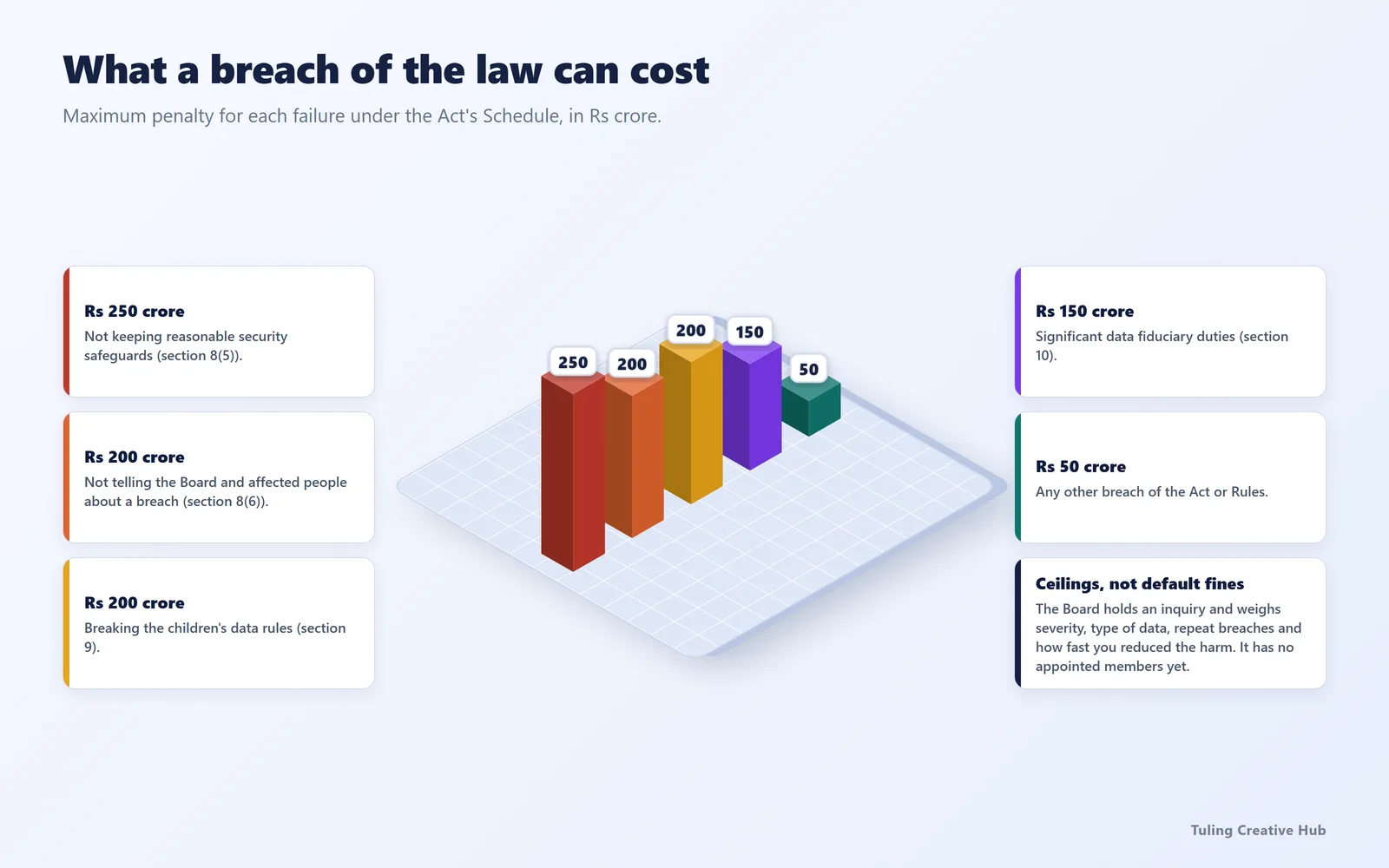
The Schedule to the Act sets maximum amounts for specified breaches. The figures below are statutory ceilings; they are not default charges or predictions of what a particular college would face.
| Failure described in the Schedule | Provision | Maximum ceiling |
|---|---|---|
| Failure to take reasonable security safeguards to prevent a personal data breach | Section 8(5) | Rs 250 crore |
| Failure to notify the Board or affected Data Principals of a breach | Section 8(6) | Rs 200 crore |
| Breach of additional obligations relating to children’s personal data | Section 9 | Rs 200 crore |
| Breach of additional obligations of a Significant Data Fiduciary | Section 10 | Rs 150 crore |
| Breach of any other provision of the Act or Rules | Residual entry | Rs 50 crore |
| A Data Principal’s breach of the duties in section 15 | Section 15 | Rs 10,000 |
| Breach of a voluntary undertaking given to the Board | Section 32 | Up to the applicable penalty for the related breach |
The relevant entry depends on the facts and legal findings. Do not add the ceilings together or describe multiple maximum penalties as an automatic result of one incident.
How is a penalty determined?
Under section 33, the Board conducts an inquiry and provides an opportunity to be heard. It may impose a penalty where it finds the breach significant. The Act directs the Board to consider factors including:
| Factor | What it may involve |
|---|---|
| Nature, gravity and duration | What happened and how long it continued |
| Type and nature of personal data | The kinds of records involved |
| Repetition | Whether the breach or failure has happened before |
| Gain or avoided loss | Any benefit gained or loss avoided |
| Mitigation | The speed and effectiveness of steps to reduce harm |
| Proportionality and effectiveness | Whether the penalty is appropriate to the breach |
| Likely impact | The effect of the penalty on the person |
Good records do not guarantee an outcome. They help the institution understand what happened, demonstrate the steps it took, and support accurate reporting.
What should a college do after discovering a breach?
Rule 7 sets out the DPDP notification steps. Prepare roles and templates in advance so the institution can respond while the facts are being established.
| Step | Timing under Rule 7 | Practical action |
|---|---|---|
| Assess and record awareness | Start promptly | Preserve relevant logs, identify affected systems and data, and name an incident owner |
| Notify each affected Data Principal | Without delay | Explain the breach, likely consequences, mitigation, steps the person can take, and a contact point |
| Notify the Board | Without delay | Report the nature, extent, timing, location and likely impact as required |
| Send detailed information to the Board | Within 72 hours of becoming aware, unless a longer period is allowed in writing | Provide the required details, including facts, reasons, mitigation and remedial measures |
The response plan should identify who can make these decisions, who contacts affected people, how vendors escalate incidents, and where the institution stores the incident record. Do not wait for a complete forensic investigation before beginning the notification process required by the Rules.
CERT-In reporting is a separate question. Its directions apply to specified entities and listed incident types, so assess the institution and incident against the current directions rather than assuming every personal data breach has an identical CERT-In deadline.
What should be ready before an incident?
- A named incident lead and escalation path for IT, management, communications and legal advice.
- Current contact details and incident-reporting terms for processors and other vendors.
- A process to preserve relevant access and security logs.
- Draft notice workflows for affected people and the Board, ready for fact-specific completion.
- A way to record when the institution became aware, what it did, and when notices were sent.
- A rehearsal that tests decisions and handoffs, not just the technical response.
The 24-week checklist includes breach preparation among its suggested work stages. The deadline guide explains the scheduled commencement dates.
Sources
- Ministry of Electronics and Information Technology, The Digital Personal Data Protection Act, 2023: sections 8, 9, 10, 15, 32, 33 and the Schedule.
- Ministry of Electronics and Information Technology, The Digital Personal Data Protection Rules, 2025: Rule 7.
This post provides general information, not legal advice. The institution should confirm its reporting duties with qualified advisers.
Update log
- 18 November 2026: first published.
Frequently asked questions
What is the maximum DPDP Act penalty?
The highest Schedule ceiling is Rs 250 crore for failure to take reasonable security safeguards to prevent a personal data breach. It is a ceiling, not an automatic fine.
Are DPDP penalties fixed?
No. The Board may impose a penalty after an inquiry and an opportunity to be heard, where it finds the breach significant. The Act lists factors for determining the amount.
How soon must a college report a personal data breach?
Under Rule 7, notify each affected Data Principal and the Board without delay. Send the Board the detailed information within 72 hours of becoming aware, unless the Board allows a longer period in writing.
Does one incident automatically mean multiple maximum penalties?
No. The Schedule sets maximum amounts for different kinds of breach. Whether multiple provisions apply, and what penalty is appropriate, depends on the facts and the Board's statutory process.
Should colleges check CERT-In reporting too?
Yes, assess it separately. CERT-In directions cover specified entities and incident types; do not assume that every campus incident has the same reporting duty or deadline.
Facts last checked: 14 November 2026. Rules and dates change, so confirm with your own advisers before acting.
Rehearse your college's breach response
Map who assesses an incident, who approves notices, and where the evidence and vendor contacts are kept.
Talk to our team- DPDP Act
- Data breach
- Penalties
- College compliance