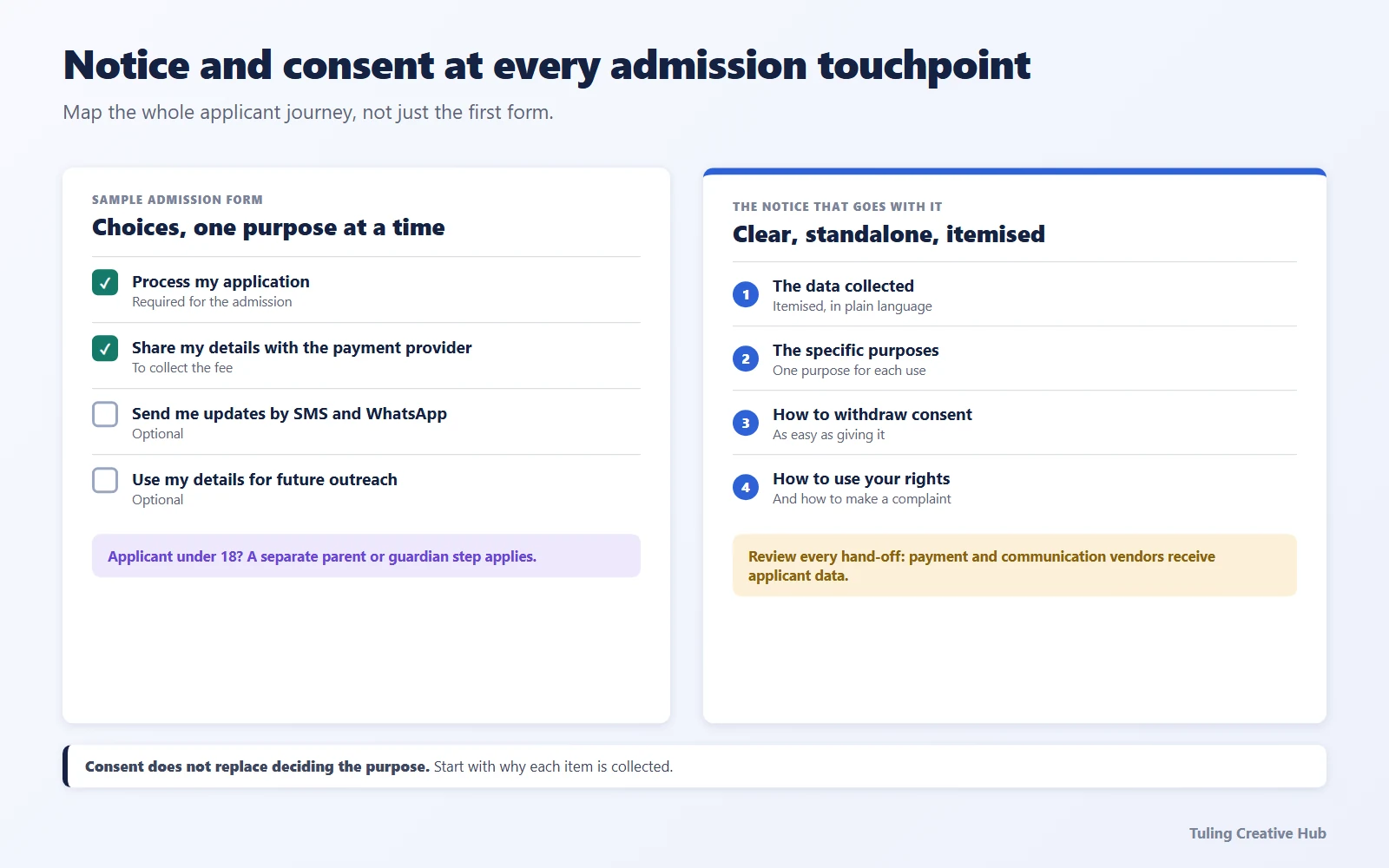
School and college admissions can collect personal data through several channels: an enquiry form, an application portal, uploaded documents, an in-person office, email, messaging or a third-party assessment or payment service. School applicants are often children, so the institution should assess the children’s-data provisions as part of the journey. A notice and consent process should be planned around what actually happens—not copied from a generic website policy.
This guide explains a practical review method. The institution should confirm legal interpretation and wording with qualified advisers before putting a notice into use.
This draft is designed for schools and higher-education institutions. The existing DPDP Act for colleges pillar provides college-specific legal context. The existing guide to children’s data and parent consent focuses on colleges, but schools also need to assess the applicable children’s-data requirements.
During a six-month software pilot at one college, the admissions walkthrough surfaced hard-copy student documents and a practical minimisation question: when a staff member only needs to check whether a document was submitted, do they need to open every file in the student’s profile? For a real application, trace who handles paper copies, when they are digitised, which roles can inspect the contents, and whether a simple “received/missing” status would meet the task. This is an anonymized workflow observation, not a legal finding; the data-mapping guide explains how to map both the paper and digital steps.
Start with the admission journey
Draw the steps from first enquiry through application, assessment or selection, enrolment and unsuccessful applications. For schools, include parent or guardian involvement and age-aware routes; for colleges, include counselling, entrance tests or other relevant stages. For each step, record what information is collected, who provides it, which staff use it, which systems receive it, and what happens next.
| Stage | Questions for the admissions or school office team |
|---|---|
| Enquiry | What contact details are requested, and what follow-up is expected? |
| Application | Which fields and documents are needed for the stated application purpose? |
| Verification | Who checks documents, and are copies exported or shared? Does the process involve a parent or guardian? |
| Assessment or selection | Which information informs the decision, and who can access it? |
| Payment | Which payment provider receives transaction or applicant details? |
| Communication | Are messages about the application separate from promotional communications? |
| Unsuccessful application | What is retained, for what reason, and when is it reviewed for deletion? |
Include paper applications if the institution later digitises them. A separate inventory may also help manage paper-only records even where they are outside the Act’s digital-data scope.
What should the notice explain?
Section 5 of the Act and Rule 3 of the 2025 Rules are the starting points for reviewing notices. The Rules describe a clear, plain-language notice that can be understood on its own, with an itemised description of personal data and the specific purposes of processing. They also address how a person can withdraw consent, exercise rights and make a complaint.
For an admissions workflow, check that the notice tells the applicant and, where appropriate, the parent or guardian, in understandable terms:
- which data is requested or generated at each relevant step;
- the specific purpose for each use, such as evaluating an application or administering enrolment;
- which routes or tools are available to act on consent or exercise applicable rights;
- how to contact the institution with a question or grievance; and
- whether a service provider receives data on the institution’s behalf, where relevant to the notice and process.
Do not assume that a long privacy policy linked from the footer automatically provides the information needed at the point of collection. Have advisers review the notice against the exact Rules, the data being collected and the user journey.
Consent is not a substitute for deciding the purpose
The Act provides for consent and specified legitimate uses. Before adding a checkbox, the institution should be able to explain why it needs the data and which legal basis it is assessing for that purpose. A checkbox cannot cure an unclear purpose, unnecessary collection or an inaccurate statement about what happens to the data.
Where consent is the basis, review how the choice is presented, recorded, linked to the relevant purpose and withdrawn. Avoid treating a broad acceptance of terms as permission for unrelated uses. Keep promotional communications separate from messages that are necessary to process an application, and get legal advice on the exact design.
For school admissions and applicants under 18, carefully assess the specific requirements for children’s personal data and any applicable exemption. Do not treat a relationship field on a form as proof of parental consent.
An OTP sent to a number entered on an application can show that someone controls that number; by itself, it does not establish that the person is an identifiable adult or the applicant’s parent or lawful guardian. Use a verification approach permitted by the applicable Rules, link the consent evidence to the verified adult’s record, and retain enough information to show what was verified and when. A phone number or checkbox alone should not be treated as proof of verifiable parental consent.
Review every handoff
A form is only the first point in the flow. Trace the data into the admissions system, spreadsheets, email, document storage, payment gateway, SMS or messaging provider, and any counselling or examination platform. For each handoff, check the purpose, responsible owner, access, vendor arrangement and retention plan.
If a school or college exports applicant lists for an event or campaign, document that use separately and ask whether the notice and legal basis cover it. Include providers in the school and college data-mapping guide. The college compliance checklist is a college-focused starting point, not a school-specific checklist.
A practical review checklist
- Walk through the admission process on desktop and mobile, including any paper or assisted route.
- List every data field and document and record why it is needed.
- Identify the point where each notice is shown and whether it is understandable without searching elsewhere.
- Separate application processing from optional promotional or unrelated uses.
- Design an age-aware route for under-18 applicants, subject to legal review.
- Record the consent or other basis assessed for each purpose and the evidence retained.
- List vendors, staff access, exports, retention triggers and deletion actions.
- Test the process with a sample application and confirm what happens after withdrawal, rejection or enrolment.
- Assign an owner to review the notice when the form, purpose or vendor changes.
The college DPDP checklist places notices within the wider readiness programme. The children’s data article covers college examples; schools should separately verify how the children’s-data provisions apply to their processes.
Sources and review note
- Ministry of Electronics and Information Technology, The Digital Personal Data Protection Act, 2023, including sections 5, 6, 7 and 9.
- Ministry of Electronics and Information Technology, The Digital Personal Data Protection Rules, 2025, including Rules 3 and 10.
It is general information, not legal advice. Notice wording and consent flows should be reviewed for the institution’s specific processing.
Frequently asked questions
Can one privacy notice cover every school or college process?
A notice may support more than one process if it clearly explains the relevant data and specific purposes, but a general policy should not be assumed to satisfy every collection-point requirement. Review the actual journey and applicable rules.
Does every school or college data use rely on consent?
Not necessarily. The Act includes consent and specified legitimate uses. The institution should identify and document the basis that applies to each purpose rather than treating consent as a universal answer.
What if an applicant is under 18?
Assess the children's-data provisions before collecting or using the applicant's information. The general requirements and any narrow, purpose-specific exemptions need to be reviewed against the actual processing. The existing guide to [children's data and parent consent](/blog/dpdp-childrens-data-parental-consent-for-colleges) focuses on colleges; schools should assess the same provisions in their own context.
Review your admissions data journey
Tuling offers operational DPDP readiness audits and implementation support for education institutions. The initial consultation is free; a full audit and implementation engagement are paid and scoped after discussion. We help institutions work toward compliance, but do not provide legal certification or guarantee an outcome.
Request a free consultation- DPDP Act
- School admissions
- College admissions
- Consent