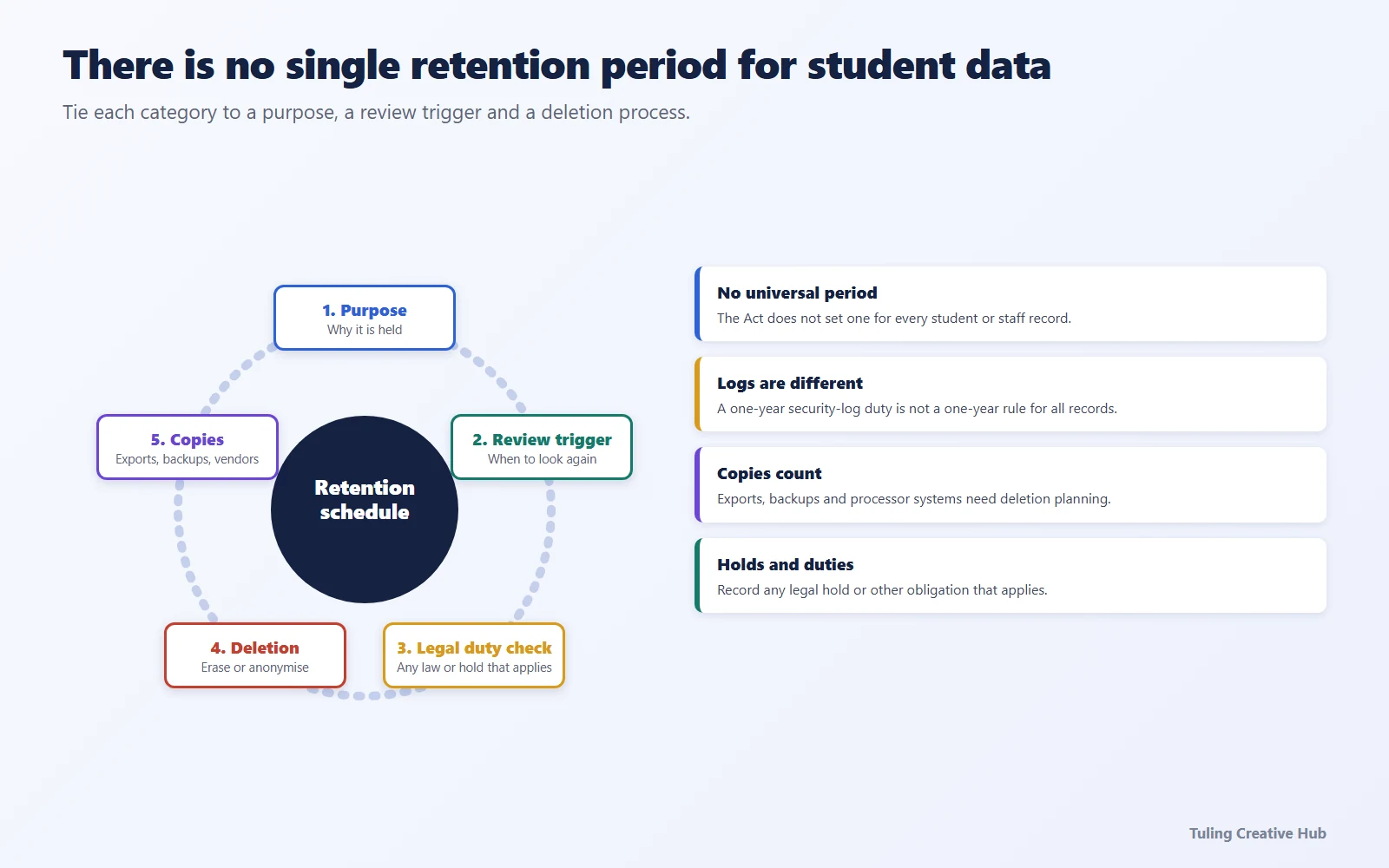
Schools and colleges keep records for many reasons: to evaluate applications, support learning, record attendance, issue reports or results, collect fees, employ staff and communicate with families or alumni. The question is not simply “How many years should we keep everything?” It is which records are still needed, for what purpose, and what legal or institutional obligations affect the decision.
The DPDP Act includes erasure requirements when the purpose is no longer served, subject to retention where required by law. It does not create one universal retention period for every pupil, student or staff record. A school or college should build a schedule that reflects its actual processing and have it reviewed by qualified advisers.
This draft is designed for schools and higher-education institutions. For college-specific legal context, see the DPDP Act for colleges pillar. The school and college data-mapping guide explains how to identify records and their copies.
Why a single deletion date does not work
An application document, school report or college examination result, attendance record, safeguarding or health record, fee transaction, transport record and family or alumni contact do not necessarily serve the same purpose. They may be held in different systems, by different departments and under different legal or operational requirements.
A schedule that says “delete all student data after graduation” may remove records the institution must retain. A schedule that says “keep everything indefinitely” may retain data after a purpose ends without a documented reason. The institution should assess each category rather than applying a blanket rule.
Build a retention schedule
Use a table that connects a record to its purpose and the event that triggers review.
| Record category | Purpose | Review or end trigger | Other obligation to check | Action and evidence |
|---|---|---|---|---|
| Unsuccessful applicant file | Application assessment and follow-up | Selection cycle or defined process close | Applicable admissions, dispute or recordkeeping requirements | Review, restrict access or delete as approved |
| Pupil or student academic record | Learning, attendance and academic administration | End of the relevant school or academic purpose | Education, examination or other applicable requirements | Retain only the categories with a documented basis |
| Safeguarding, health or support record | Student welfare or support | Review when the specific purpose changes or ends | Applicable child-protection, education or other requirements | Restrict access and confirm retention with advisers |
| Fee and payment record | Accounting and reconciliation | Completion of the relevant accounting purpose | Applicable financial, tax or audit requirements | Apply approved schedule and record disposal |
| Staff record | Employment administration | Employment ends or a specific purpose ends | Employment, tax or other applicable requirements | Review category by category |
| Marketing contact | Optional communications | Withdrawal or end of the relevant purpose | Applicable communication and suppression needs | Stop use as required and retain only necessary evidence |
| Security log | Security monitoring and investigation | Rule-based period or approved security need | DPDP Rules and other applicable directions | Configure and review the specific log requirement |
This table is a planning example, not a legal retention schedule. Each institution needs to confirm applicable obligations and its own purposes.
Separate a purpose from a storage habit
Ask each department:
- What decision or service does this record support?
- Is the information still needed for that purpose?
- Has the purpose ended for all or only some fields?
- Is there another applicable law, obligation, dispute or legal hold that requires retention?
- Can access be restricted while the institution resolves a retention question?
- Which copies are held by vendors, staff devices, exports, email or backups?
- Who approves the decision and what evidence will be retained?
If an institution has a lawful reason to retain a record after one purpose ends, document the reason and restrict subsequent use to the permitted purpose. Do not silently repurpose retained information.
Keep security-log requirements in context
Rule 6(1)(e) includes a one-year period for specified logs and personal data needed to detect and investigate unauthorised access or similar activity. That requirement should not be confused with a direction to retain every student’s personal data for one year.
Confirm which systems and logs are covered, how they are protected, and whether other applicable directions impose additional requirements. Keep system logs separate from academic or administrative records in the retention schedule.
Include vendors and backups
Deleting a record from a primary application may not remove exports, support tickets, backups or data held by a processor. Ask vendors how deletion works, what copies persist, what the contract says, and how deletion or transition can be evidenced. Do not promise that every backup copy disappears immediately unless the actual backup design supports that claim.
Backups may follow a different retention cycle from live records. Work with IT and providers to document backup retention, access controls, restore procedures and how deletion decisions are reconciled before restored data returns to normal use. A controlled suppression record or equivalent reconciliation step may help prevent a previously erased record from being reintroduced; it is one possible technical control, not a mechanism specifically prescribed by the Act or Rules. Document the chosen design and obtain advice on its legal sufficiency.
For each system, be able to explain the sequence: what is removed or restricted in the live service, which processor or export copies need action, how backup copies expire or are handled, and what happens if an older backup is restored. The institution’s retention schedule should describe the real process rather than promise instant permanent deletion.
Make the schedule operational
Assign a process owner and a review date to each category. Put retention triggers into system configuration where possible, but preserve human review for categories with legal holds, disputes or exceptions. Train staff not to keep unofficial “just in case” copies after the approved process ends.
The college compliance checklist includes retention among broader readiness tasks, but schools should adapt it to their context. For requests to erase or correct information, see the school and college rights and grievances guide.
Sources and review note
- Ministry of Electronics and Information Technology, The Digital Personal Data Protection Act, 2023, including sections 8(7) and 8(8).
- Ministry of Electronics and Information Technology, The Digital Personal Data Protection Rules, 2025, including Rules 6 and 8.
It is general information, not legal advice. Confirm each retention period against current law and the institution’s obligations.
Frequently asked questions
Does DPDP specify how many years a school or college must keep all student records?
There is no single period for every record in the Act. The school or college should assess the purpose, applicable legal and institutional obligations, and the Act's erasure requirements for each category.
Does the one-year security-log rule apply to all student information?
No. The one-year period in Rule 6(1)(e) concerns specified logs and personal data needed to detect and investigate unauthorised access or similar activity; it should not be presented as a general retention period for every student record.
Should a school or college delete records as soon as a learner leaves?
Not automatically. Graduation may end some purposes, but other records may be needed for a continuing purpose or an applicable legal obligation. Assess each category and document the decision.
Review your retention and deletion schedule
Tuling offers operational DPDP readiness audits and implementation support for education institutions. The initial consultation is free; a full audit and implementation engagement are paid and scoped after discussion. We help institutions work toward compliance, but do not provide legal certification or guarantee an outcome.
Request a free consultation- DPDP Act
- Data retention
- Student records
- Education compliance