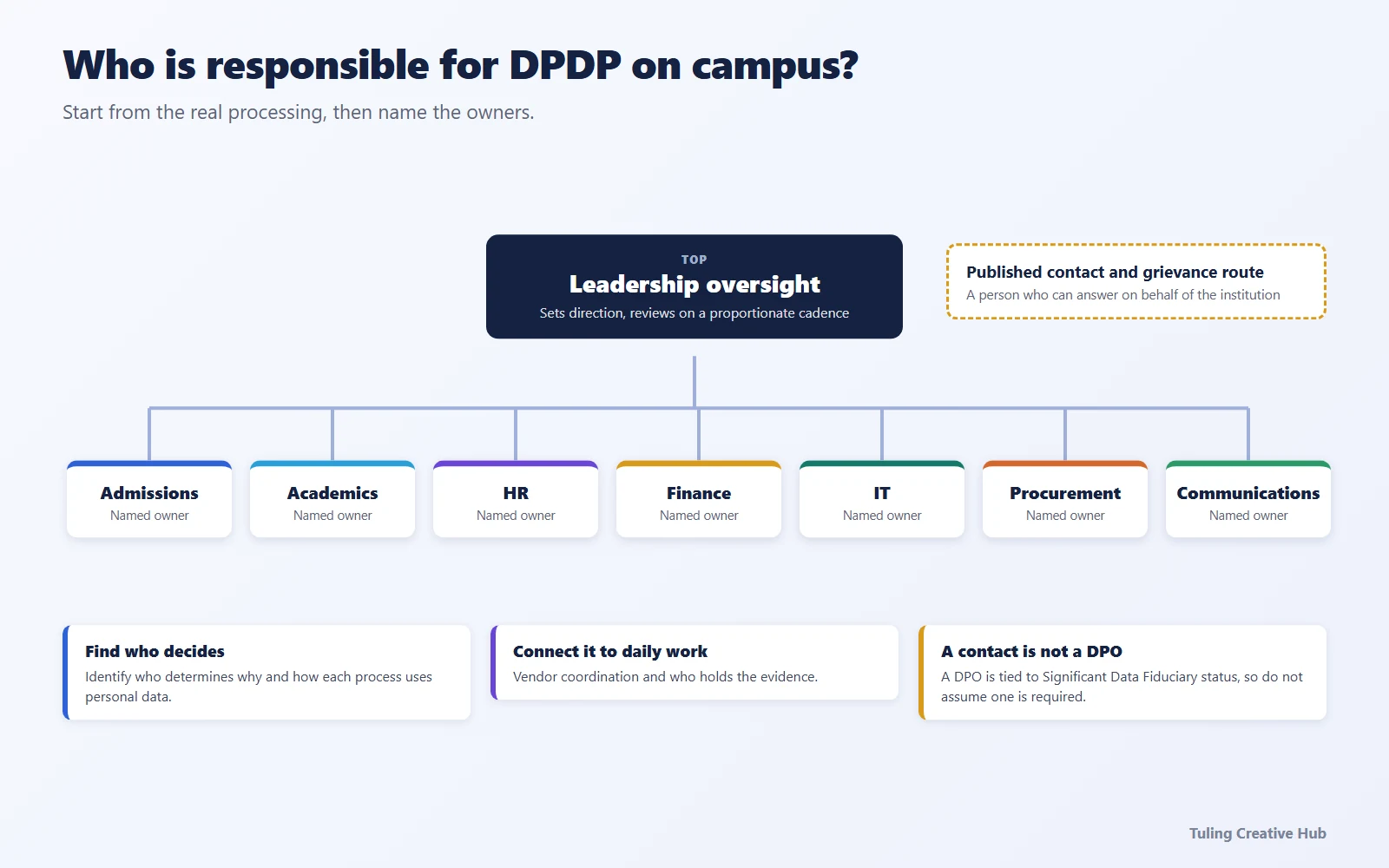
DPDP work often stalls when everyone assumes another office owns it. A school principal or administrator, college registrar, IT team, procurement office and a trust or university may all have roles in processing. Clear governance helps them make decisions together.
The first task is not to appoint a committee by title. It is to identify which legal entity and operational team is responsible for each activity, then make sure decisions, escalation and evidence have owners.
This draft covers both schools and higher-education institutions. The existing DPDP Act for colleges pillar provides college-specific legal context. The college compliance checklist offers a suggested sequence that schools should adapt.
Start with the actual processing
The Act distinguishes a data fiduciary, which determines the purposes and means of processing, from a data processor that processes on its behalf. A school, college, university, society, trust or other entity may make these decisions depending on the activity. The organisation name on a website or vendor contract is not enough to settle every role.
For each important process, ask:
- Which entity decides why the data is collected and used?
- Who chooses the systems, fields, access and retention practices?
- Does another entity process the data only on instructions, or does it determine a separate purpose?
- Which organisation communicates with the person and handles requests or grievances?
- Who can approve a change in purpose, vendor or disclosure?
Document questions where the answer is not clear and obtain legal advice before relying on a role allocation.
Review access when a student’s journey changes
In the six-month software pilot described in the data-mapping guide, the admissions workflow raised a role-handoff question: should an admissions counsellor retain profile access after the admission work is complete? That should be a deliberate, institution-approved decision—not an automatic side effect of the account remaining active. Review access when a person changes role or a process ends.
Apply the same purpose check to the registrar’s view. If the task is fee follow-up, a fee-due status may be enough; do not expose admission documents unless the registrar’s other duties require them. These are least-privilege design examples, not role assignments prescribed by DPDP. Keep a record of who approved the access, what task requires it and when it should be reviewed or removed.
Create an operating model
Senior leadership should sponsor the programme and resolve cross-campus questions. Day-to-day work should sit with named owners who know their processes.
| Role or team | Example responsibility |
|---|---|
| Governing body, trust or executive sponsor | Set priorities, approve resources and receive material risk escalations |
| Programme owner | Maintain the work plan, issue log, owners and review cadence |
| Principal, school administrator, registrar and admissions | Applicant, pupil and student processes, notices and request routing |
| Teachers, academic and examination teams | Learning records, attendance, results, assessments and access |
| Safeguarding or student-support lead | Coordinate appropriate handling of welfare and support-related records |
| HR and finance | Staff, payroll, fee and financial processes |
| IT and security | System inventory, access, logs, safeguards, backups and incident coordination |
| Procurement and legal advisers | Vendor terms, role questions, contracts and legal interpretation |
| Communications | Clear notices, affected-person communications and approved channels |
| Department process owners | Confirm what happens in practice and maintain evidence |
These are suggested operational roles, not a list of positions prescribed by the Act.
Do not confuse a contact person with a DPO
The Act’s provisions should be read carefully: a Significant Data Fiduciary must appoint a Data Protection Officer, while data fiduciaries have obligations relating to publishing contact details of a person able to answer questions about processing. These are not interchangeable labels.
Do not claim every school or college must appoint a DPO. Check whether a government notification or the institution’s circumstances make the Significant Data Fiduciary requirements relevant. If the institution does appoint a privacy lead voluntarily, describe the role accurately and do not imply a statutory designation unless it applies.
Connect governance to daily processes
The programme owner should make sure there is a working route for:
- maintaining the school and college data map;
- reviewing school or college admission notice and consent flows;
- handling rights requests and grievances;
- assessing vendors and changes to systems;
- reviewing retention and deletion decisions;
- escalating and documenting incidents; and
- training staff who collect, export or share personal data.
For each route, name a primary owner and a backup. Define who can make decisions, who must be consulted and where the evidence is kept.
Set a proportionate review cadence
Use a regular meeting to track open actions, overdue decisions, incidents, vendor changes and new processing. The agenda should focus on decisions rather than simply reporting completion percentages. Escalate issues that affect multiple campuses or need legal interpretation.
Review the operating model after a merger, new campus, major system change, new student service or change in applicable law. A policy document is useful only if the people named in it know what to do.
Avoid common governance mistakes
- Naming a single “DPDP officer” without giving the person authority, time or escalation support.
- Assuming the ERP provider owns the institution’s legal responsibilities.
- Treating every entity in a university group as having the same role.
- Calling every privacy contact a statutory DPO.
- Assigning an action to “IT” or “management” without an individual owner and due date.
- Recording completion without keeping evidence of the decision or process.
The school and college data-mapping guide helps surface which departments and providers are involved. For vendor roles, see DPDP vendor due diligence for schools and colleges.
Sources and review note
- Ministry of Electronics and Information Technology, The Digital Personal Data Protection Act, 2023, including sections 2, 8(1), 8(9) and 10.
- Ministry of Electronics and Information Technology, The Digital Personal Data Protection Rules, 2025, including Rule 9.
It is general information, not legal advice. Confirm role allocation and any Significant Data Fiduciary status with qualified advisers.
Frequently asked questions
Is every school or college automatically a data fiduciary?
The role depends on who determines the purposes and means of the relevant processing. A school, college, university, trust or another entity may have the role for different activities; assess the facts and obtain advice.
Does every school or college need a Data Protection Officer?
The Act requires a Data Protection Officer for a Significant Data Fiduciary. Do not assume a school or college is or is not in that class without checking any applicable notification and the institution's circumstances.
Can a school or college hand DPDP responsibility to its ERP vendor?
No. Section 8 addresses the data fiduciary's responsibility for processing undertaken on its behalf by a processor. A vendor can support controls and workflows, but the institution retains its own responsibilities.
Discuss DPDP roles and readiness
Tuling offers operational DPDP readiness audits and implementation support for education institutions. The initial consultation is free; a full audit and implementation engagement are paid and scoped after discussion. We help institutions work toward compliance, but do not provide legal certification or guarantee an outcome.
Request a free consultation- DPDP Act
- School governance
- Data fiduciary
- Education compliance