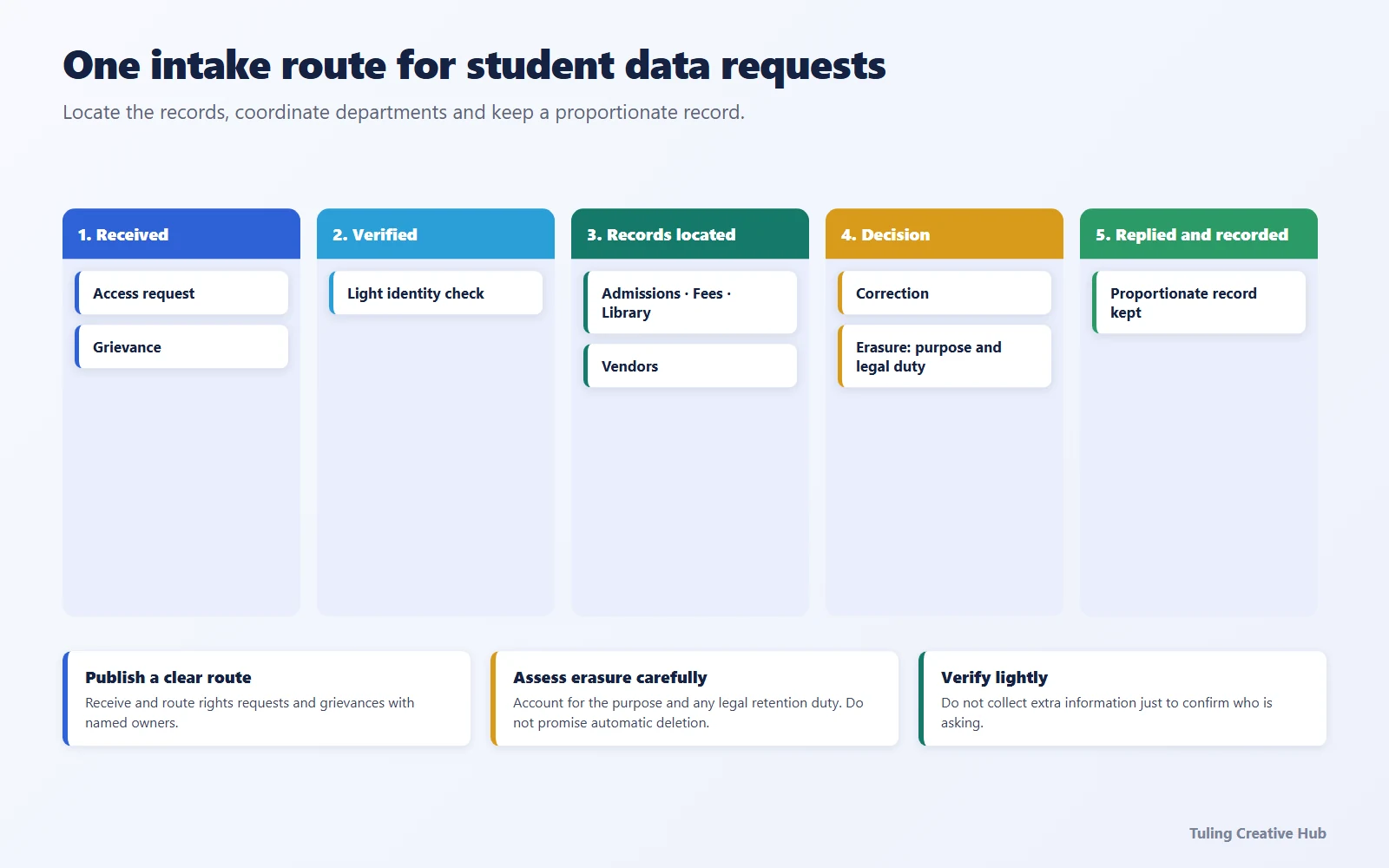
A pupil or student, parent or staff member may ask to access information, correct a record, seek erasure or raise a grievance. A school or college needs a way to receive the request, identify the right owner, find relevant records and document the response. A process that depends on one staff member’s inbox is difficult to manage when the request involves multiple departments or vendors.
This article is a school and college workflow guide, not a substitute for the current Act, Rules or legal advice. The existing DPDP Act for colleges pillar provides college-specific legal context; the operational steps here should be adapted to a school’s structure.
What requests might arrive?
The Act provides rights that include access to information about personal data and processing, correction, completion and updating, erasure, grievance redressal and nomination. The details and procedure should be confirmed against the Act and Rules in force when the institution publishes its process.
Requests can come from pupils, students, applicants, parents or guardians, and staff. They may relate to more than one record: an address correction might affect admissions, attendance, the learning platform, fee records and communications. A parent or guardian acting for a child requires an appropriate route, but the institution should verify authority and applicable rules rather than assuming it from a relationship field.
Design one clear intake route
Publish a contact route that people can find without knowing which department holds their information. The form or email route should explain what information is needed to identify the person and understand the request. Avoid asking for extra identity documents or sensitive details unless the institution has assessed that they are needed.
An authenticated student or employee portal can make it easier for a current user to submit a request, but it should not be the only route if applicants, parents or former staff cannot access it. A published contact channel can also work when the institution has a proportionate way to verify identity and, where relevant, a person’s authority to act for someone else. The Act does not prescribe a particular portal or a universal DPO-approval step; assign the work to an accountable person or team, and appoint a DPO where the institution’s status requires one.
| Intake step | Practical control |
|---|---|
| Receive | Route requests from the published channel to a monitored queue |
| Acknowledge | Record the date, request type and a reference number |
| Verify | Use a proportionate process to confirm identity or authority |
| Clarify | Ask only for information needed to understand the request |
| Assign | Name an owner and departments or processors to consult |
| Decide | Record the applicable provision, facts and any advice obtained |
| Respond | Use clear language and explain the action or reasoned outcome |
| Close | Record completion, communications and any follow-up |
These are operational steps, not a claim that the Rules prescribe this exact tracker or sequence.
Locate the records and coordinate departments
The request owner should know how to search the institution’s systems and paper-based workflows. A request may require coordination among a principal or school administrator, registrar, admissions, teachers, examinations, finance, HR, student services, IT and one or more service providers.
Use the school and college data map to identify likely locations, copies, owners and vendors. Record which searches were performed and whether a vendor needs to help. Do not assume that deleting one visible system record automatically removes email copies, exports or records held by a provider.
Assess correction and erasure carefully
For a correction request, identify the authoritative source and whether the change needs to reach downstream records. For erasure, distinguish data that is no longer needed for its stated purpose from records that may need to be retained to comply with another applicable law or obligation. The Act addresses erasure and provides for retention where required by law; the institution should assess the particular record and seek advice where the answer is not clear.
Do not set a single deletion rule for all learner records. An attendance record, report card, examination record, fee record, applicant document and marketing contact may have different purposes and retention considerations. If some records must be retained, document the reason and limit their use and access to what is needed for that obligation. If data is erased, check relevant exports, email, processor systems and other copies rather than assuming that removing a profile from one screen completes the work. The institution’s backup and recovery process should also prevent erased data from quietly returning to routine use after a restore; this is an operational control, not a prescribed one-click or backup-purge method. The school and college retention guide is a companion draft intended for review before publication.
Run a grievance process people can use
The Rules require a published grievance-redressal mechanism and a response period that does not exceed 90 days. Make the route visible in the relevant notice and on the institution’s website. Assign a person or team to monitor it, escalate complex cases and report overdue items.
The grievance owner should be able to explain how a person can raise an issue, what information helps identify the case, how the institution will communicate and what route applies if the person remains dissatisfied. Have legal advisers confirm the exact wording and procedure before publication.
Keep a proportionate record
For each case, record the request, verification performed, departments and processors consulted, decision, communications and closure. Limit access to staff who need it. Keep the case record only for a documented purpose and under the institution’s retention schedule; the request log itself contains personal data.
Review a sample of closed cases periodically. Look for repeated delays, systems that are hard to search, inconsistent decisions, or a request type for which no department has a clear owner.
Sources and review note
- Ministry of Electronics and Information Technology, The Digital Personal Data Protection Act, 2023, including sections 11 to 14.
- Ministry of Electronics and Information Technology, The Digital Personal Data Protection Rules, 2025, including Rule 14.
It is general information, not legal advice. Confirm current rights, procedures, time limits and exceptions with qualified advisers.
Frequently asked questions
What data rights should a school or college be ready to handle?
The Act provides rights including access to information, correction, completion and updating, erasure, grievance redressal and nomination, subject to the provisions and applicable rules. Confirm the current requirements before publishing a process.
Does every request need to be answered within 90 days?
The Rules require a published grievance-redressal system with a response period that does not exceed 90 days. That should not be presented as a universal deadline for every type of rights request without checking the applicable provision.
Can a school or college refuse an erasure request?
The answer depends on the purpose, the legal requirements and the facts. The institution should document its assessment and obtain advice where a statutory retention obligation or other exception may apply.
Does an erasure request mean the institution must delete everything immediately?
No. The institution should verify the request, assess the purpose and any applicable legal retention obligation, and decide what action is appropriate. A request form is not the same as an approved deletion, and the Act does not prescribe a one-click deletion interface.
Plan a campus rights-request workflow
Tuling offers operational DPDP readiness audits and implementation support for education institutions. The initial consultation is free; a full audit and implementation engagement are paid and scoped after discussion. We help institutions work toward compliance, but do not provide legal certification or guarantee an outcome.
Request a free consultation- DPDP Act
- Student rights
- Grievance handling
- Education compliance