A Sunday in November. The college is holding its semester examinations, and a dozen non-teaching staff and several faculty members are invigilating. Nobody is scheduled to work. On Monday some of them mention it to their HOD, and the HOD says “we will adjust it sometime.” Three months later nobody remembers who worked how long, the leave is never given, and the same people grumble when the next Sunday duty is announced.
This example is invented, but every college has a version of it. Extra duty is real work that falls outside the timetable and the shift. This guide explains a clean way to handle it in a staff leave management system: staff claim the hours, and approved hours are redeemed as leave. It describes how that works in the Tuling HR module, and how to write a policy that is fair and easy to run. For the wider picture of college HR software, see HRMS for colleges: why a corporate HR tool falls short.
Staff leave management: what extra duty is, and what it is not
Extra duty is work beyond the scheduled shift or timetable: invigilation on holidays, admission drives on weekends, events, inspections, special classes, preparing accreditation files.
It is different from two things people confuse it with:
- Overtime pay. That converts extra hours into money. Extra duty as described here converts them into leave. Some colleges pay overtime to some staff groups and give leave to others. Your policy should say which.
- Comp-off. A comp-off is usually a day off given for a day worked on a holiday. It is closely related, and some colleges use one term for both. The difference that matters is whether your rule works in whole days or in hours. Extra duty works in hours, which suits part-day work.
Part 1: claiming the hours
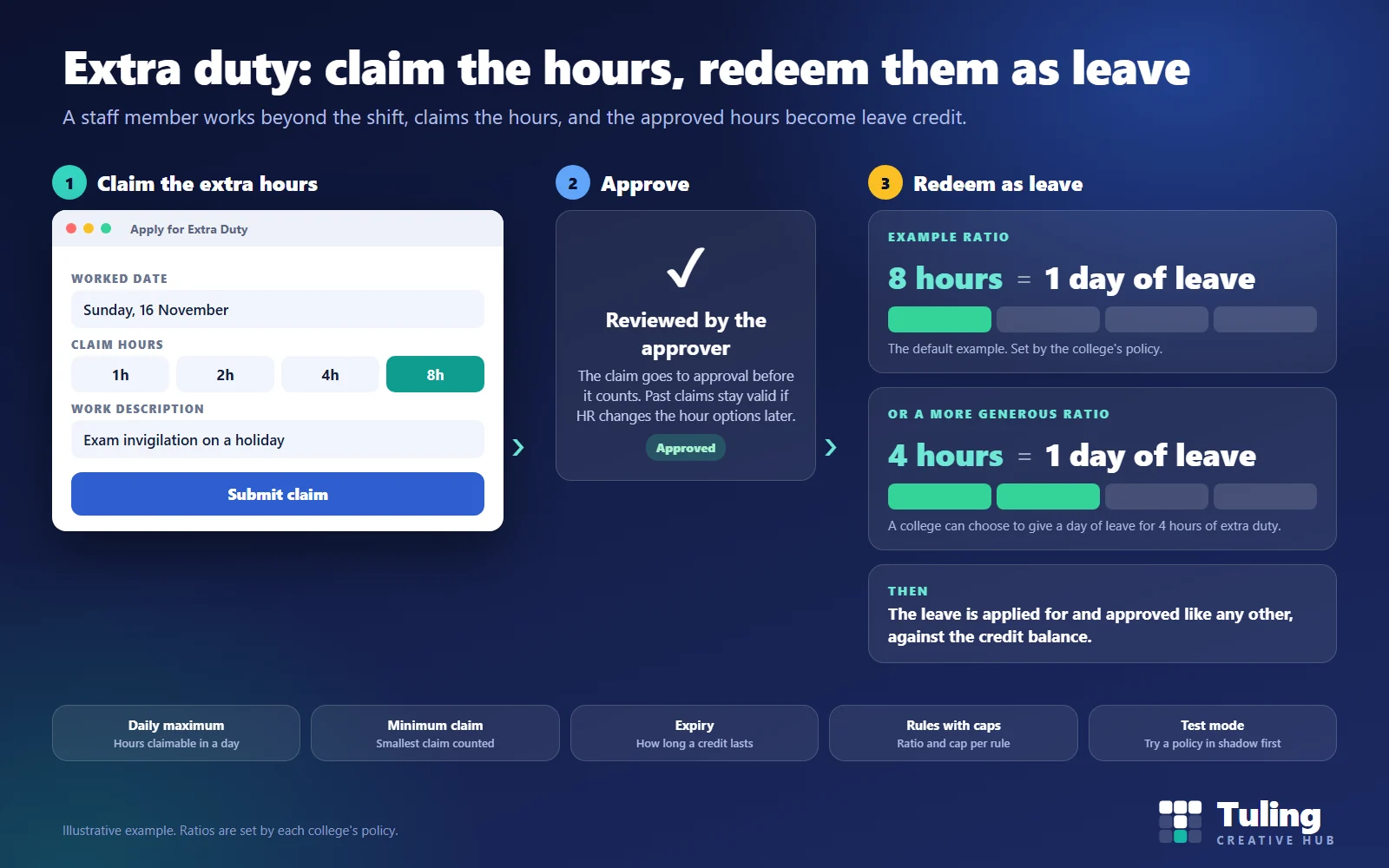
A staff member applies for extra duty from the self-service portal. The form asks for:
- the date worked
- the hours claimed, chosen from a list that HR sets up
- a description of the work
- optional remarks
HR controls the list of claimable hours. The usual options are 1, 2, 4 and 8 hours, and HR can change them. Past claims stay valid if the list changes later, so a claim made in September is not affected by a change in November.
The point of a dropdown, and not a free-text box, is consistency. Staff cannot claim 3 hours and 20 minutes one day and 3.5 the next. Everyone claims in the same units.
The form also asks for a description of the work, because a claim without a description is difficult to approve and impossible to audit. “Exam invigilation, afternoon session, main block” is a claim an approver can check. “Extra work” is not.
Part 2: redeeming the hours as leave
Approved hours become leave credit at the ratio set in the policy.
| Ratio | What it means | When a college chooses it |
|---|---|---|
| 8 hours = 1 day of leave | A full working day of extra duty earns a day of leave | The default example, and the simplest to explain |
| 4 hours = 1 day of leave | Half a working day of extra duty earns a day of leave | A college that wants to reward extra duty more generously, or compensate for unpleasant duties |
Neither is “right”. The ratio is a decision about fairness and cost. A 4-for-1 ratio is generous, and a college using it should check that departments can cope with the leave it creates, especially in exam months.
Once the credit is in a staff member’s balance, they apply for leave in the normal way, and the credit is used against it. The leave goes through the same approval as any other leave. It is not a separate process.
The policy: five settings that keep it fair
In the Tuling HR module, extra duty runs on a policy that HR builds as a draft and then makes live. The settings that matter:
- Effective dates. The policy applies from a date, so changing the rules does not rewrite the past.
- Daily maximum. The most hours that can be claimed for one day. This stops a single entry of 16 hours from distorting the balance.
- Minimum claim. The smallest amount that counts. A five-minute overrun is not extra duty.
- Rules with a condition, a ratio and a cap. Each rule can say, for example, that a minimum amount of overtime must be met, convert the hours at a chosen ratio, and cap how much a single rule can credit.
- Expiry. How long an unused credit lasts, so nobody accumulates a year of credit and takes it all in March.
There is also a test mode. A new policy can be run in shadow mode first, which evaluates claims against the rules without changing balances, so you can see what the policy would do before it goes live.
The rule that protects the balance
In Tuling, extra duty credit comes only from approved claims. HR cannot add extra duty balance by typing in a number.
That sounds restrictive, and it is deliberate. If a balance can be edited by hand, it stops being a record of work done. In a dispute, you want to be able to say: this credit exists because these hours were claimed on these dates and approved by this person. A hand-edited number cannot say that.
Scenarios
These are illustrative scenarios, not client cases.
Scenario 1: exam invigilation on a Sunday
Twelve staff invigilate a Sunday paper for a full working day. Each claims 8 hours, with the description “Semester exam invigilation, Sunday”. The controller of examinations approves the claims the next day. With an 8-for-1 policy, each person now has 1 day of leave credit. When one of them applies for a Friday off after a long week, the credit pays for it.
Scenario 2: half a Saturday at an admission drive
A faculty member spends half a day at an admission fair. They claim 4 hours. With an 8-for-1 policy that is half a day of credit. With a 4-for-1 policy it is a full day. The college decided on 8-for-1 for routine work and wrote it into the policy, so there is no argument on the day.
Scenario 3: a claim that is too large
A staff member claims 8 hours for a day on which the policy’s daily maximum is 6. Because the limit is written into the policy, the approver does not have to negotiate it case by case: the rule is the rule, and it applies to everyone the same way.
Scenario 4: credit that expires
A staff member earns 3 days of credit in April and does not use them. The policy gives credit a six-month life. In October the unused credit expires. Because staff were told the rule in advance, it is not a surprise.
Scenario 5: a new, more generous rule
The principal decides that duties on public holidays should earn a better ratio. HR drafts a new rule, runs the policy in test mode for a week against real claims, checks the results, and then sets it live from the first of next month. Past credit is unchanged.
Mistakes to avoid
- No written policy. Without one, every claim is a negotiation.
- Approvers who approve everything. Approval means checking that the work happened. Ask approvers to check against the duty roster or the event notice.
- No expiry. Credit piles up, and the cost lands in one month.
- Ratios that differ in practice. If 8-for-1 is the policy but one department grants 4-for-1, you have an unfairness complaint waiting to happen.
- Changing the rules without a date. Always set an effective date.
- Mixing up leave credit and pay. If some staff are paid overtime instead, keep the two policies clearly separate.
A short checklist for your policy
- Which staff groups are covered?
- What counts as extra duty, and what does not?
- What is the ratio, and is it the same for all groups?
- What is the daily maximum and the minimum claim?
- Who approves, and what do they check?
- How long does credit last?
- When does the policy start?
- Who explains it to staff?
How Tuling approaches it
Extra duty is part of Tuling HCM, the HR module of the college ERP. See extra duty leave conversion and leave management. Staff claim through self-service, approvers review the claims, HR sets the claimable hours and the policy, and the credit is redeemed against leave. Pricing is by quote, based on your staff and student numbers, campuses and modules; see how pricing works.
Related: for leave policies in depth, see faculty leave management system for colleges.
Data protection note
Extra duty records show who worked when and where. Keep access to claims limited to the staff member, their approver and HR, and keep the records only as long as you need them. See DPDP governance and roles for schools and colleges.
How this guide was made
The claim form, the policy settings and the rule that credit comes only from approved claims were checked against the working Tuling HR module. The ratios, scenarios and numbers are illustrative examples; set your own in your policy. This guide was drafted with AI assistance and reviewed by the Tuling team.
Frequently asked questions
What is extra duty in a college?
It is work done beyond a staff member's scheduled shift, such as invigilating exams on a holiday, staffing an admission drive on a Sunday or supporting an event. Staff claim those hours, and approved hours become leave credit.
How many hours equal one day of leave?
That is the college's choice. A common example is 8 hours for 1 day of leave. A college that wants to reward extra duty more generously can set 4 hours for 1 day. In Tuling the ratio is set in the extra duty policy.
Who approves an extra duty claim?
Claims go to an approver before they count. Your approval chain decides who that is, usually the head of department or a designated authority.
Can HR add extra duty balance by hand?
No. In Tuling, extra duty credit comes from approved claims, and HR cannot top it up by typing a number. That keeps the balance a record of work actually done.
Does unused extra duty credit expire?
The policy can set an expiry, so unused credit does not build up indefinitely. Decide the period and tell staff before it starts.
See extra duty set up for your college
Bring your current extra duty rules. We set up a sample policy, claim some hours and redeem them as leave on screen.
Book a demo- Extra duty
- Leave management
- College HR
- Attendance