Ask a head of admissions where admissions are lost and the answer can be marketing: not enough enquiries. Look closely at the enquiry register and a different pattern can appear. The enquiries came. They were not followed up in time, or were followed up once, or by someone who did not know what had already been said.
This guide is for counsellors and the people who manage them. It describes how a student enquiry management system can support a daily routine, a suggested seven-day cadence for a new lead, what to record after each call, how to automate the dull parts, and what a head should watch. It builds on lead scoring and counsellor assignment, which decides who gets which lead.
The three habits that matter
- Contact quickly. The first call sets the tone. Families often ask several colleges at once, so a fast, helpful reply is worth aiming for. This is our view from how admission teams work, not a measured statistic.
- Record everything. If the counsellor leaves, falls ill or is reassigned, the next person should pick up without asking the family to repeat themselves.
- Always leave a next step. Every conversation ends with a dated task: call again, send the fee sheet, confirm the visit. A lead with no next task is a lead that is slipping.
A counsellor’s day in admission enquiry management
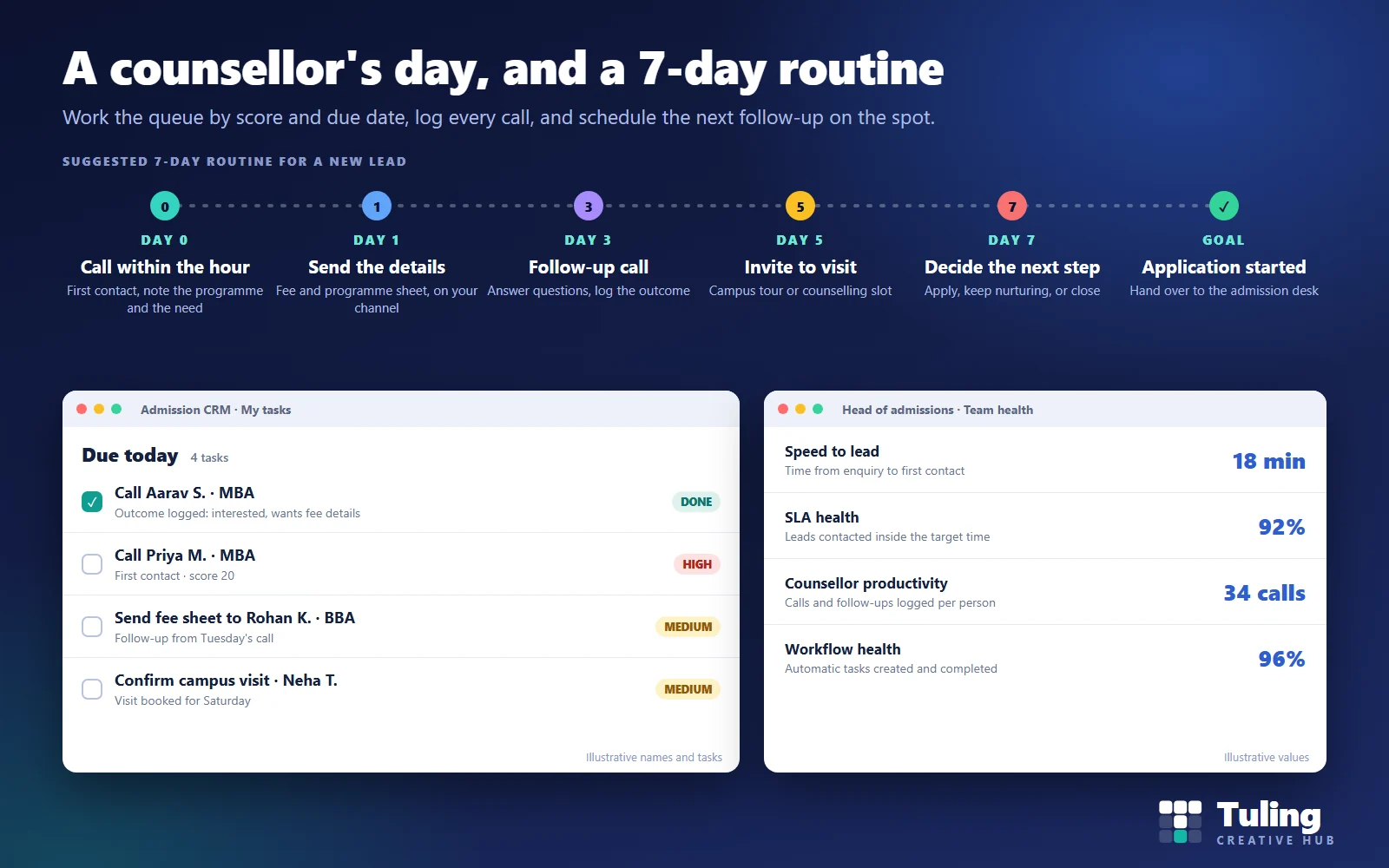
The Admission CRM is built around a daily work queue.
Morning. Open the queue. Leads are ordered by score and by when the follow-up is due, so overdue and high-scoring leads are at the top. Start there.
During the day. Place calls. After each call, log the outcome and notes on the lead and set the next follow-up task with a due date and priority. If a lead has opted out of messages, the CRM respects that and does not message them.
Before leaving. Check the task list for tomorrow. Anything overdue today should be rescheduled with a reason, not left to drift.
What to record after a call
| Field | Example |
|---|---|
| Outcome | Interested, wants fee details |
| Programme and timing | MBA, joining next session |
| Concerns | Hostel availability, scholarship |
| Next task | Send fee sheet, due tomorrow |
| Priority | Medium |
A good note is one that someone else could act on. “Spoke to parent” is useless. “Parent wants hostel for a girl student, asked about the October fee instalment, will visit on Saturday” is a plan.
A suggested 7-day routine for a new lead
This is a suggestion to adapt, not a rule. Test it against your conversions.
Day 0: call within the hour. Make first contact while the enquiry is fresh. Confirm the programme, the person’s situation and the best time to call. Log the outcome.
Day 1: send the details. Send the fee and programme information on the channel the person prefers. Email is part of the CRM. SMS and WhatsApp are available as a paid integration, set up on request with your provider.
Day 3: follow-up call. Answer questions raised by the information. Log what was said and set the next task.
Day 5: invite to visit. Offer a campus tour or a counselling slot. A visit is often a sign of serious intent, so record it, and consider giving it extra points in scoring.
Day 7: decide. Move the lead to one of three places. If they are ready, start the application. If they are interested but not ready, set a longer nurturing task, such as a call after the board results. If they are not interested, close the lead with a reason.
Goal: application started. When a lead becomes an applicant, the application moves through the admission stages. See how the CRM hands an applicant to the admission module.
Scenario 1: a counsellor with 120 open leads
Illustrative numbers.
A counsellor holds 120 active leads and no routine. Each morning she scrolls through a list and calls whoever she remembers.
What to change. Use the queue instead of memory. Sort by score and due date, work the top fifteen to twenty, and make sure every call leaves a dated next task. If 120 is too many for one person, ask the head to lower the cap on open leads per counsellor so new leads go elsewhere.
Scenario 2: the weekend rush
Illustrative scenario.
A college holds an open day on Saturday. Eighty people fill an enquiry form at the gate. On Monday morning the leads are all new, all with the same source, all unassigned.
What to change. Score them by programme, share them across counsellors by a distribution rule, and have each counsellor start day 0 contact on Monday morning. Do not leave the whole batch to one person.
Scenario 3: a telecaller and a counsellor share the work
Illustrative scenario.
A team uses telecallers for first contact and counsellors for the conversations that follow.
What to change. Split the routine. Telecallers own day 0 and day 1, and hand over to counsellors when a lead is warm, for example after a visit request. Reassign the lead in the CRM so the history moves with it and the counsellor sees every note.
Scenario 4: a lead goes quiet
Illustrative scenario.
A lead was keen on day 0 and has not answered the day 3 call or the day 5 invitation.
What to change. Do not keep calling. After day 7 set one longer task, for example a message after a relevant date such as results, and then close it if there is no reply. Respect any opt-out. A tidy pipeline is easier to forecast, and a persistent counsellor who ignores a “stop” request creates a complaint.
Automate the dull parts
The CRM has a visual workflow designer. A workflow can trigger on an event, such as a new lead or a change of status, and create tasks and notifications. For example:
- When a new lead arrives, create a day 0 call task for the assigned counsellor, due the same day.
- When a lead’s status changes to the one you use for “interested”, create a day 1 task to send the details.
- When a status changes to the one you use for a booked visit, create a reminder task for the counsellor to confirm it.
Automation does not replace the conversation. It makes sure the reminders happen.
What the head of admissions should watch
The CRM reports measures that show whether the routine is working:
- Speed to lead: the time from enquiry to first contact.
- SLA health: how many leads are contacted inside your target time.
- Counsellor productivity: calls and follow-ups logged per person.
- Workflow health: whether automatic tasks are being created and completed.
- Stage conversion: where enquiries drop out between stages.
Use them to coach, not to blame. A counsellor with a low conversion rate may simply have been given the weakest leads, which is why scoring and fair assignment matter. For how to read the funnel, see admission funnel metrics and the seat forecast.
How Tuling approaches it
The Admission CRM includes lead capture, scoring, fair distribution, calls and tasks with reminders, real-time notifications for the team, templates and conversation history per lead, opt-out and suppression lists, a workflow designer, an applicant portal and a dashboard. It does not place calls; counsellors log them. Email is part of the CRM. SMS and WhatsApp are available as a paid integration on request. Pricing is by quote; see how pricing works.
Data protection note
Follow-up means contacting people about their data. Say in your enquiry form how you will contact them, keep an opt-out list and honour it, and avoid contacting under-18 applicants in ways your notice did not describe. See DPDP notices and consent for school and college admissions.
How this guide was made
The product behaviour described here was checked against the working Admission CRM. The cadence, scenarios and numbers are illustrative suggestions, not client data and not an industry standard. This guide was drafted with AI assistance and reviewed by the Tuling team.
Frequently asked questions
How quickly should a counsellor contact a new enquiry?
As fast as your team can sustain, with a written target such as the same working day or within the hour. The Admission CRM measures speed to lead, the time from enquiry to first contact, so you can see whether the target is met.
How many follow-ups should a lead get?
There is no universal number. A common pattern is a first call, a message with details, a second call, an invitation to visit, and a decision point within about a week. Adjust it using your own conversion data, and respect anyone who opts out.
What should a counsellor record after a call?
The outcome, anything the person said about programme, fees or timing, and the next task with a due date. The CRM keeps calls, outcomes and notes on the lead.
Can follow-up tasks be created automatically?
Yes. The Admission CRM has a workflow designer that can trigger on events such as a new lead or a status change and create tasks automatically.
Does the CRM place calls?
No. Counsellors place calls with their own phones or systems and log the outcome in the CRM. Messaging over SMS and WhatsApp is available as a paid integration on request.
See the counsellor queue and task list
We set up a sample queue with your programmes and show how a counsellor's day looks, from the first call to the next task.
Book a demo- Admission CRM
- Enquiries
- Counsellors
- College admissions