Imagine it is November and a senior faculty member resigns. (This is an invented example.) The semester has six weeks to run. Within a day the HOD has to plan who will teach her classes, the library wants its books back, the accounts office needs to settle an advance, the IT team must close her accounts, and HR has to work out what she is owed.
In a college that runs on email and phone calls, each of these happens separately, and nobody has a single view of what is done. Weeks later the former employee is still chasing her settlement. This guide describes a cleaner process and how it works in the Tuling HR module. It is the exit end of the chain described in HR and payroll software for colleges by size and staff group.
An exit is a chain
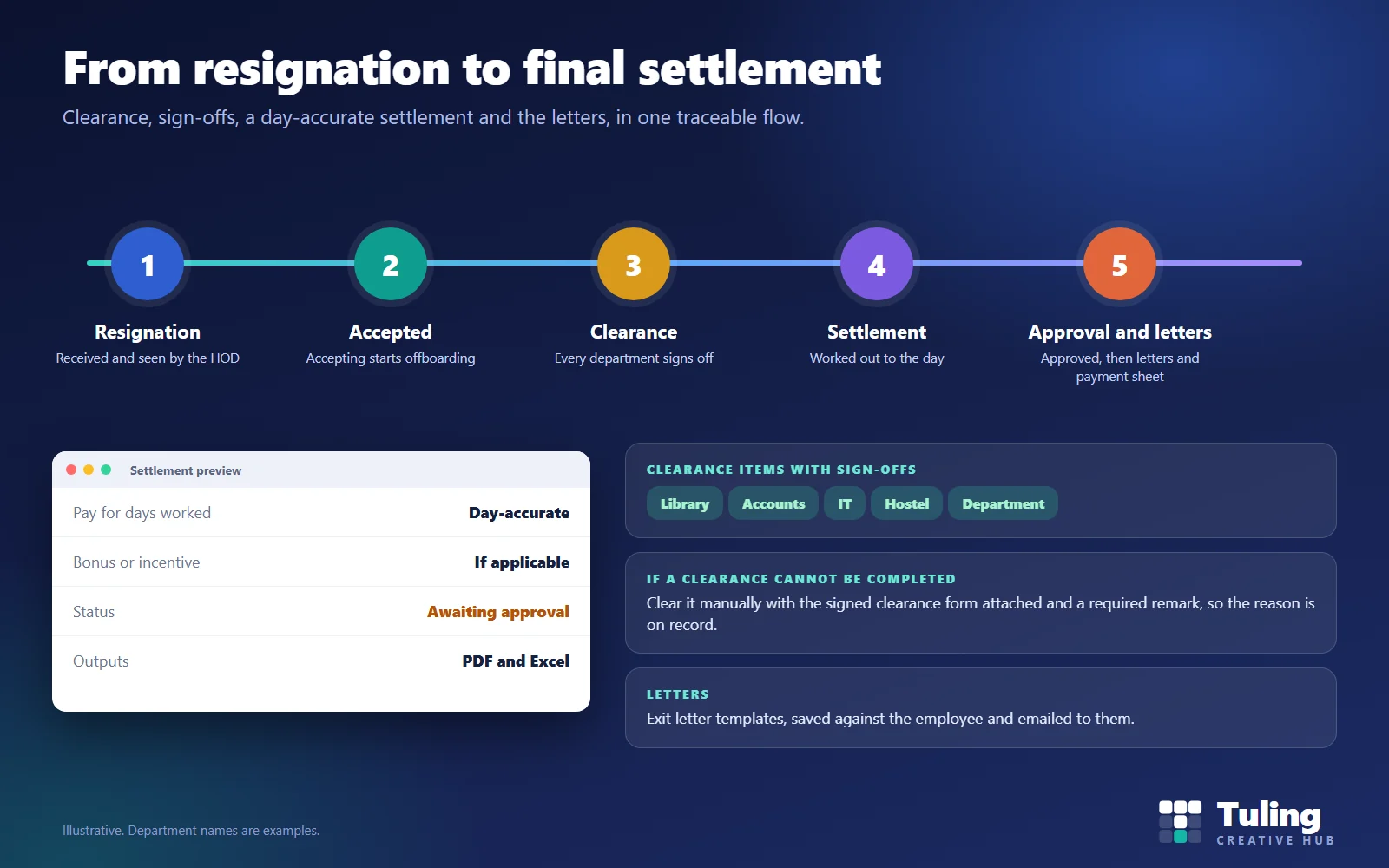
- Resignation received. The request is recorded, and the HOD can see it.
- Accepted. HR accepts the resignation, and that starts offboarding.
- Clearance. Every department signs off.
- Settlement. Pay up to the last day, and anything else owed, is worked out.
- Approval and letters. The settlement is approved, letters are issued, and accounts receive a sheet to pay from.
The Tuling HR module displays requests moving from left to right through these stages, and the button on each row is always the next action. Accepting a resignation starts its offboarding.
Step 1 and 2: the request and the HOD
Voluntary resignations submitted by a department’s faculty appear on the HOD’s desk. That matters in a college, because the first practical question is academic: who covers the classes? See the head of department’s desk.
When HR accepts a resignation, offboarding starts. Ask the employee for a handover note: pending work, student matters and anything a successor needs to know. The offboarding screens have room for handover requirements and knowledge transfer notes.
Step 3: clearance
Clearance is the checklist of things an employee must return or settle before leaving: library books, keys, equipment, accounts and advances, hostel or department items. Each is a clearance item with a department sign-off, and every department signs off.
This is where exits stall, because it depends on many people. Two practices help:
- Name the sign-off owner for each department, and a backup.
- Allow a recorded exception. If a clearance cannot be completed, for example because the employee cannot return an item, it can be completed manually with the signed clearance form attached and a required remark. The reason is on file, so the decision can be defended.
Step 4: the settlement
The final settlement is the money side. In Tuling HCM it is calculated to the day, not on a flat 30-day assumption. The inputs include pay for days worked and any bonus or incentive. Details such as leave encashment or notice-period recovery depend on your own contract and policy, so write them down and apply them consistently.
The output is a PDF and an Excel breakdown. The spreadsheet is designed for the accounts team to use for payment, so they do not retype figures.
Step 5: approval, letters and payment
A settlement waits for approval before anything is paid. The question “Approve this settlement?” should be answered by someone other than the person who prepared it. After approval:
- The exit letter is produced from a template and saved against the employee, and can be emailed to them.
- The payment sheet goes to accounts.
Letters matter to the leaver, who often needs them for their next job.
Scenarios
These are illustrative scenarios, not client cases.
Scenario 1: a faculty member resigns mid-semester
The resignation arrives in November. The HOD sees it, arranges temporary cover and agrees a handover plan. HR accepts it, offboarding starts and the department signs off its items as the semester winds down. The settlement is prepared for the last working day.
Scenario 2: a clearance that cannot be completed
A warden cannot return a master key that was lost years ago. The administration decides to clear the item manually, attaches the signed clearance form and records the reason. The exit is not held up, and the decision is on file.
Scenario 3: the accounts office needs a sheet
Instead of asking HR for numbers, accounts download the settlement spreadsheet and process payment from it. No retyping, so no typing errors.
Scenario 4: a dispute over days worked
The leaver questions the number of days paid. HR shows the day-accurate calculation and the attendance behind it. The conversation takes minutes.
Scenario 5: a leaver needs a letter
A former lecturer needs an exit letter for a new employer. It is already in the record, and HR emails it the same day.
Mistakes to avoid
- No handover. The cost shows up in the next semester.
- Settlements prepared and approved by the same person. Separate the roles.
- Clearance by phone. If it is not recorded, it did not happen.
- Unwritten policy. Decide notice, encashment and recovery rules in advance.
- Slow letters. They cost you goodwill.
How Tuling approaches it
Resignation and exit, with clearance and final settlement, are part of Tuling HCM, together with the document hub that stores letters against the employee. Pricing is by quote; see how pricing works.
Data protection note
Exit records contain salary, conduct and personal details. Keep access limited, and decide how long records are retained after a person leaves. See how long to keep student data under DPDP for the thinking on retention periods, which applies to staff data as well.
How this guide was made
The exit stages, clearance, settlement and letters described here were checked against the working Tuling HR module. The people, dates and scenarios are illustrative, and your own contract and policy decide what a settlement includes. This guide was drafted with AI assistance and reviewed by the Tuling team.
Frequently asked questions
What are the steps in an exit process?
The resignation is received, the HOD sees it, HR accepts it and offboarding begins, each department signs off its clearance items, the final settlement is calculated and approved, and letters are issued and the payment sheet goes to accounts.
What if a department will not sign off clearance?
A clearance can be completed manually with the signed clearance form attached and a required remark, so the reason is on record.
How is the final settlement calculated?
In Tuling HCM it is calculated to the day, not on a flat 30-day assumption, and produced as PDF and Excel breakdowns for the accounts team. Check your own contract and policy for what is included.
Who approves a settlement?
A settlement waits for approval, and approval requires a decision before payment. Decide in your policy who the approver is.
Can exit letters be generated from templates?
Yes. Letters are created from templates, saved against the employee record, and can be emailed to the employee.
See an exit from resignation to settlement
We walk through a sample resignation, department clearances, the settlement preview and the letters.
Book a demo- Resignation
- Final settlement
- Offboarding
- College HR